
Category

News

A woman working on a computer

Making BESS Even Better

By | News

Interval House won’t settle for the status quo, and neither will the women it serves. This month, Interval House staff will implement an extensive redesign of the BESS program to ensure that no woman is falling through the gaps.

The new program relies on information gathered from a special report entitled, “Barriers to Employability and Employment for Women Survivors of Intimate Partner Violence.” The report is based on interviews with past participants in the BESS program, along with input from other community agencies who serve domestic violence survivors. The study concludes that programs designed to assist abused women with their search for employment must take a holistic, wrap-around approach that recognizes the barriers these women face. It also recognizes how women’s needs change at different stages of recovery and healing.

The new BESS program being introduced this fall will:

  • Help reduce barriers that women face as a result of the abuse they endured
  • Ensure women can access our services no matter what stage they’re at in their healing
  • Support women in creating and executing action plans for their self-identified goals
  • Offer standalone workshops covering a variety of topics, on a schedule that better accommodates women’s diverse needs
  • Respond to the need for longer-term counselling through individual and group counselling
  • Open doors for women who are looking for work; and help women achieve their career dreams.

Intimate partner violence is about power and control. As a result, many survivors have lived with isolation, immigration issues, lack of education—and a variety of other conditions that were imposed on them by their partners. The revamped BESS program will address the conditions that tend to negatively affect abused women when they begin looking for work to support themselves and their children. The new BESS program will take aim at knocking down those particular barriers because that’s what gives survivors a fighting chance to get on the path to healing and independence.

Testimonial #1 

“I was living in an apartment with five roommates. I had been out of work for six months and wasn’t getting any interviews for retail jobs. I came to the program after fleeing an abusive relationship and unsure of how to stand on my own two feet. My experience with the BESS program was life changing. It gave me a support system and a place where I could explore my employment options and learn more about the job market and myself. I learned how to write an effective resume as well as interview skills so that I could land my dream job at a non-profit organization using my facilitating and computer skills. If BESS did not exist, I would probably be on social assistance and stumbling through life unsure of how to reach my goals. I am now living on my own in a safe neighbourhood—it’s a place that I never imagined possible three months ago.”

BESS Graduate

Testimonial #2 

“My dearest family and friends did not know what I was going through because I became a pro at being invisible. The emotional and psychological abuse left me hopeless, like a body with no soul. I didn’t want to live. I didn’t want to face anyone or talk to anyone, so I isolated myself.. I went into the [BESS] program thinking like a victim and feeling sorry for myself. I came out of the program thinking like a survivor and proud of my accomplishments. Although I am shunned from my community and certain family members do not wish to speak me, I am thankful that I am not in a dangerous situation. I am applying for jobs now and I know I am worth something, I’m not stupid, and I am far from being alone.

– Pamila, BESS Graduate

Testimonial #3 

“I’ve been an Interval House donor for many years and have always trusted them to get good value for my money. I’m impressed with the BESS program – it’s truly unique among Toronto shelters. It breaks the cycle of abuse by giving women the tools and opportunities they need so they can really manage on their own. Of course, the proof is in the extraordinary success BESS graduates experience, relative to other employment programs.”

– Sandra, Toronto, Interval House donor

Women standing in the Interval House kitchen space

Annual Open House 2016

By | News

This year’s 2016 Open House was a huge success. Many thanks to everyone in attendance including our guests, staff, and volunteers. Special thank you to our speakers who inspired and demonstrated the importance of what Interval House does for the community and for the women and children fleeing intimate partner violence.

Fazia Mohammed, gave a touching speech where she explained our new BESS (Building Economic Self-Sufficiency) program. She explained how its expansion aims to catch survivors of intimate partner violence who often have a tendency fall through the cracks of the system. The new BESS program works in way where women can enter the program at any point and take whichever workshops they require.

Nada*, a graduate of the BESS program, then spoke to the program’s success and effectiveness. She described her experience with BESS, and how she first arrived without self-confidence or esteem. Coming from an abusive relationship, she felt incapable and worthless. She didn’t feel as though she was employable. This changed through BESS. She found the motivation, confidence, and value in herself. This is exactly the purpose of BESS.

During the event, ongoing tours of the shelter were offered to guests by staff members. To show the people who support Interval House, exactly where their support is going. We look forward to the year ahead, and to the next annual Open House.

*Name changed for client’s protection

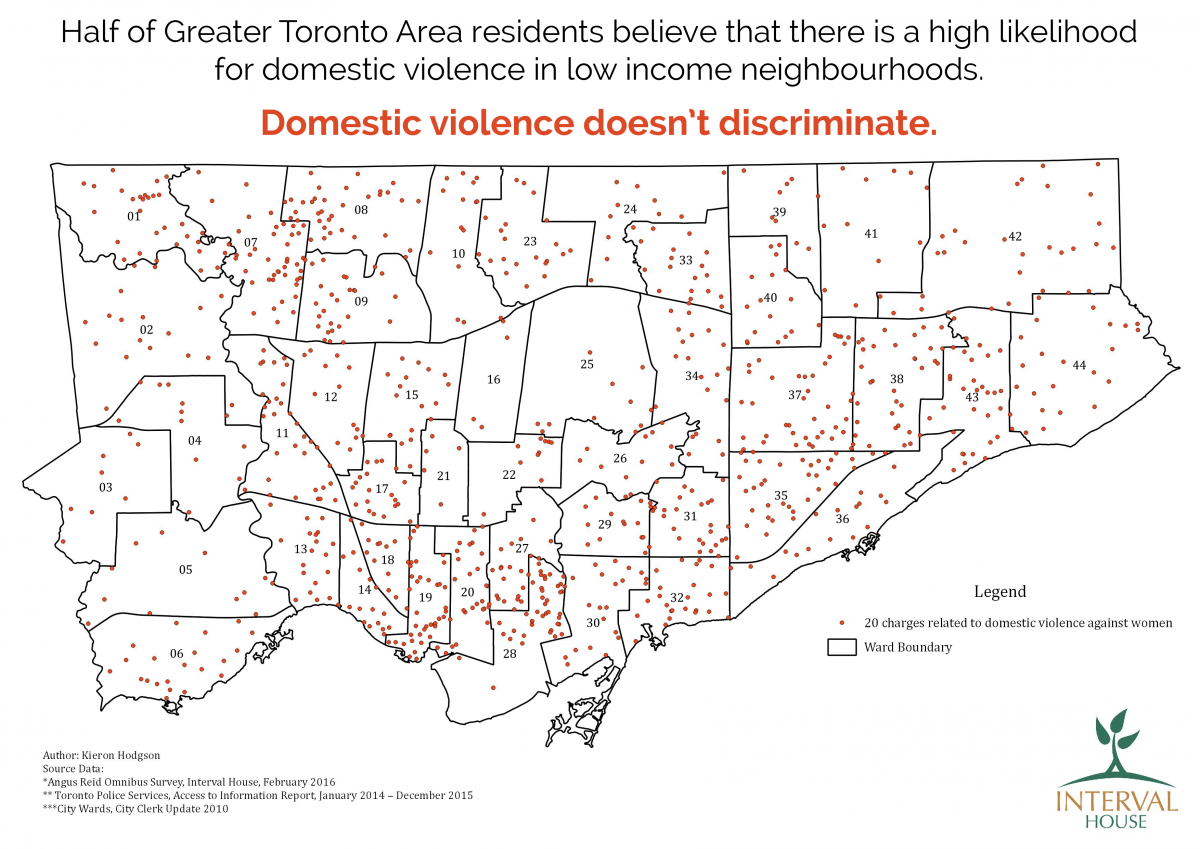
A map of the GTA indicating likelihood of domestic violence

Domestic Violence Doesn’t Discriminate

By | News

Domestic violence happens everywhere and can happen to anyone.

In a recent survey conducted by Interval House, we found that half of Greater Toronto residents believe domestic violence is more likely to occur in low-income areas. But we know that domestic violence doesn’t discriminate.

We took police data from 2014 to 2015 and mapped domestic violence-related charges across the city of Toronto. Each dot represents 20 charges related to domestic violence against women between 2014 and 2015.

It’s clear: Domestic violence knows no boundaries.

school bus

The challenges of starting a new school when you live in a shelter….

By | News

When women arrive at our shelter with their children, they’re given the opportunity to change where their children go to school. Some women decide to change their children’s school because they are coming from a distance. This eliminates the stress of a long commute to school.

However, the biggest reason moms decide to change their children’s school is because of potential endangerment to their children. If a child continues attending the same school after coming to the shelter, there’s a risk that the abuser can take them home and away from their Mom, or follow the child back to the shelter and discover where they are living. To avoid this, the Moms staying at the shelter enroll their children in a new school.

Starting a new school presents a unique set of challenges for the children staying the shelter. They often are sad to leave their friends and teachers at their old school. They worry what the kids at their new school will think of them. They worry how they explain that they live in a shelter when someone asked “where do you live?” Sometimes they worry about playdates and how to tell other kids that they can’t have people over at their home. Here at Interval House, we allow the children to make that decision for themselves. They are not required to tell anyone that they live at a shelter, and they can choose to make that information private.

Children staying at the shelter have a unique set of challenges that other children don’t have when returning to school; especially considering many kids at the shelter start a new school. Like other children who start a new school, these kids are afraid they won’t make friends, like their teachers, or know how to navigate a new place. These are normal concerns any child has when starting a new school. We’re here to help them begin their new journey in learning.

hands forming a heart shape

How to speak to someone you know who is being abused by their partner

By | News

You may know someone who has been abused by their partner.

It can be devastating to see someone you care about being hurt. You may be able to spot the signs of abusive behavior. However, the person being abused may not be able to or want to leave.

So how can you help in this type of situation?

Understand intimate partner violence and why women stay

You want to be there for your friend but you may not understand why they continue to be with someone who hurts them; be it emotionally, physically, or financially.  It is important to keep in mind that it is not the abused person’s fault for being in an abusive relationship. Before confronting someone, ensure that you understand intimate partner violence and why women stay. Understanding why abuse occurs will help you speak to the person who is experiencing it.

Speak to them privately

After learning about intimate partner violence, choose a time where you can be alone with your friend so that you can speak to them privately. Tell them that you’re concerned about their well-being. If you place shame, blame, or guilt on the abused person, there’s the possibility that you’ll further isolate them. They may already be feeling afraid and alone, it is your job to make sure they know that you are there for them.  Ensure that you’re open and that your concerns are coming from a place of love and support. They may deny that there’s a problem. Remind them that you are there to support and help them. And that whether they decide to stay or leave, you will support their decision.

Let them know that it is not their fault.

Abusers will often try to isolate their victims from their friends and families to prevent them from leaving. It is therefore, so important that you stay in touch with the person who being abused.  Encourage them to seek help and let them know that they are supported.

A piggy bank

Financial Abuse: Another Way Abusers Keep Women from Leaving

By | News

Many people think of physical or verbal abuse when they define domestic violence. But financial abuse is an important—but often overlooked—aspect of abusive relationships. What is financial abuse and how can a woman get help if she’s experiencing financial abuse?

What is financial abuse?

Financial abuse occurs when the abuser controls a woman financially. At first, he may reassure her not to worry, that he’ll take care of the bills, but this can become a slippery slope. An abuser may prevent a woman from knowing the family’s financial situation or refuse to give her access to money. He may threaten her to keep her from working and earning money. Financial abuse is extremely important because it keeps a woman dependent on her abuser, and makes it much more difficult for her to leave the relationship.

Signs of financial abuse

Here are some signs of financial abuse. In a financially abusive relationship, the abuser may:

  • Withhold money or put the woman on an allowance.
  • Steal money from her.
  • Force the woman to provide her bank account information and make transactions without her consent.
  • Prevent her from working or only allow her to work part-time.
  • Dictating the types of job a woman can work.
  • Threaten that if she doesn’t quit her job, the relationship will be over.
  • Sabotage her job by showing up at her workplace or otherwise harassing her.
  • Track her spending.
  • Refuse to give her money for necessities, such as food, gas or transportation.
  • Become the woman’s only financial source.
  • Force her to hand over any money she earns or savings she has, and forbid her access to the bank accounts.
  • Threaten to leave the relationship or refuse to support her financially, knowing that she can’t survive financially without him.
  • Max out the woman’s credit cards, or using her identity to obtain credit cards without her consent.
  • Withholding financial information from woman (ex. tax returns filed, child tax, his personal accounts, debts, etc.)

What can be done?

If a woman is in a financially abusive relationship, she can:

  • Seek support and create a plan. She can tell her family and friends about the abuse and create a plan to leave the relationship. Shelters like Interval House help women create plans to help them leave safely, and support them as they get back on their feet. Our BESS (Building Economic Self-Sufficiency) program helps women to regain their financial independence and get back into the workplace.
  • Save secretly. She can open a secret bank account, and start saving (even a little bit) until she’s ready to leave.
  • Keep copies of any financial document. If she’s able to obtain any financial documents, keep photocopies in a safe place. These can include bills, bank statements, credit card statements, and income tax returns.
  • Create a credit history. She should keep a secured credit card at a safe location, such as a family or friend’s place that she can use to build her credit.
  • Store documents in a safe place. She should start collecting important documents such as birth certificates and store them in a safe place—outside the home.
  • Build job skills. She may need extra education in order to get a job. Online courses may be a safe way to help her rebuild her skills.
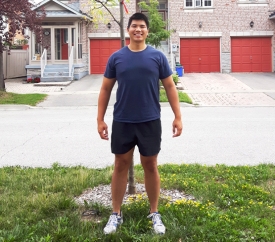
noel standing in front of a tree

Q&A with Noel Pang: Interval House’s Run Ambassador

By | News

Noel is an Interval House Run Ambassador for the Scotiabank Toronto Waterfront Marathon. He’ll be running the half-marathon to raise funds for Interval House. We were able to get in touch with Noel, and find out more about why he chose Interval House as his charity of choice.

Why did you decided to run the half-marathon?

The reason I chose the half marathon originally was because I was trying to get my younger sister to start running further distances. So right now she’s running 5 kilometers every few days.

That’s how I ended up in half-marathon versus the full, which would have been a little intimidating for her.

What is your personal running goal for the race? Do you have time you’re aiming for?

I’ve run three half-marathons but this year, I’m not going for time. This year, the way I’m raising money for Interval House is that for each amount that I reach, I will wear a piece of my uniform because I’m a paramedic. If I reach my goal of $1000, I will wear my steel toe boots which are really hard to run in. So for this race, I’m just hoping to finish it.

Why did you choose Interval House as your charity of choice to run for your half-marathon?

I like how Interval House is a small charity. And I just love how they’re a shelter that is not just for women, but also for women AND their children. So you’re protecting them from being abused, and removing them from unsafe environments. You’re also keeping them as a family so that the kids can grow up knowing that their mom was there. I just love how it’s not just a shelter where people go to stay, but it’s a place for women to get the tools they need to get jobs later on and break the cycle of abuse.

Do you have anyone in your life who you consider a role model?

I would say my mom, because when she had my sister and I, she stopped working but took care of our education.  And even though English was her second language, she made sure to keep teaching us English, and always encouraged us to take care of people around us.

What’s your personal fundraising goal to support Interval House?

If I reach $200, I run the whole race in my uniform’s tactical shirt and pants, if I reach $500, I add on my helmet and safety vest, if I reach $1000 I wear steel-toe boots.

Do you think you’ll be able to finish the race in your steel-toe boots?

I think so. I spoke to another paramedic who ran 10 kilometres in full uniform with boots and he said it was difficult but do-able.

Do you any advice for other runners, especially first-time runners?

Really enjoy the run. This type of run there will be people along the way, and water stations. So really soak in the energy which will distract you from the distance. Enjoy the experience.

You can support Noel by donating to his personal page here or on Interval House’s donation page.

a woman working on a laptop

But how do women find Interval House?

By | News

Have you ever exhaustively searched for Interval House’s address and haven’t had any luck?

Don’t worry! You are not the only one looking for our address and not being able to find it. In fact we often hear from people who are trying to find our location, but can’t find it on Google, on the phone book, or in our website. No, we do not have a website glitch. We intend it that way; we keep our address confidential.

Keeping our address confidential is essential to our operations, to the safety of our staff and volunteers, and last but not least, to maintain our ability to provide safe shelter for women and their children.

When Interval House opened our doors as the first emergency shelter for women leaving abusive relationships, many people weren’t happy with our existence. Interval House received bomb threats and our operation was viewed negatively by the community and the media alike. People did not understand our purpose, and for example in 1973 under the headline “Home for Runaway Wives” a newspaper wrote about us.

While today public perception of women’s shelters has shifted, women still continue experiencing violence on an everyday basis, and many people still don’t understand that leaving an abusive partner is a very dangerous choice. When women leave, they are the highest risk of violence escalating from their abusive partner. This puts their lives at risk.  Women need to go to a place where their abuser won’t find them. This is the main reason why we do not share our location publically, and maintain our address confidential.

Even though having a confidential address helps mitigate these risks, there is still a possibility that an abuser may locate a woman at Interval House. This is why we have many other security protocols set up on site to further protect women at the shelter. Interval House would never disclose the name of a resident, or allow visitors to freely circulate into our premises.

But, if it is that difficult to find Interval House, how do women find Interval House, you may ask? Well, women come to us by referral from other women services. They typically connect with us through the Central Family Intake or contact us on our crisis phone line at 416-924-1491. And sometimes we receive calls from hospitals or police officers asking if we have space for a woman they’re working with. To put it simply, women don’t come up to our shelter unannounced. When they move in, we’ve helped them arrange the safest way to leave, and we’re ready for them when they arrive.

So do not worry if you can’t easily find our address. That is probably a good thing.

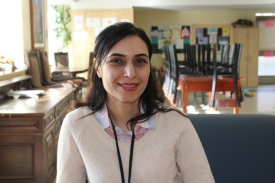
Shirin headshot

Meet Shirin: Part 6

By | News

MOVING OUT

Recently, we introduced you to Shirin, one of our long-time Women’s Counsellor Advocates. Each month, we’ve been shadowing Shirin to give you an idea of what a day’s work is like as a counsellor at Interval House.

When women move out of Interval House, staff members like Shirin help them to settle into their new homes. While their stay at Interval House is temporary – just an Interval – the support we extend to women and kids doesn’t end on moving day.

Today is the big moving day for Emmanuelle*. Emmanuelle is a bit older than some of the other residents – in her late 50s. When she first moved into the shelter, Emmanuelle was often sad and kept to herself. But over the course of her stay, Shirin has seen her begin to relax and become more positive.

“She really enjoyed the counselling groups,” says Shirin. “She gained a lot of knowledge from them and connected with the other women.”

Emmanuelle doesn’t speak English as a first language, so when she first moved into the shelter, a few of her new friends would translate for her. But she doesn’t need their help anymore – from working with an ESL tutoring volunteer, Emmanuelle’s English skills have improved and she can get by on her own.

Shirin has been working with Emmanuelle to find housing since she moved into the shelter. Together, they found a nice apartment that will feel like home for Emmanuelle, in a neigbourhood that she likes.

A few days ago, in preparation for the move, they went shopping together in the Household Boutique to pick out everything that Emmanuelle needs for her new home. She was so excited to pick out the dishes, towels, microwave and other items that she wanted to furnish her new place – and couldn’t believe all of it was donated from the community (https://www.intervalhouse.ca/take-action/kind-donations).

Last week, when she first got possession of the apartment, Emmanuelle went to clean and start moving in some of her things. Her friend from the shelter, Sheila*, accompanied her to help.

“It’s common for the women to make great friendships like that,” says Shirin. “For the women who are staying behind in the shelter, they feel happy for their friends and want to help them. They also wonder: when will it happen for me?”

What is Shirin’s hope for women like Emmanuelle when they leave Interval House?

“I hope that they have a life free from violence,” says Shirin. “That they will never have anyone abuse them, and just be safe and happy.”

This is the final post in our series taking you step-by-step through a day in the life of a counsellor at Interval House.

*Names and some details have been changed for safety and privacy.

a gun

Domestic Violence and Guns: Canada’s Unspoken Problem

By | News

At Interval House, we hear countless stories from women who have survived and fled domestic violence. We hear stories about abusive partners who pointed a gun at them and threatened that if they ever leave, they won’t live to see another day. And unfortunately, death threats are not uncommon when it comes to an abusive relationship. It’s another reason why women feel like they can’t leave.

Just south of the Canadian border, the Supreme Court of the United States recently decided in the ruling of Voisine vs. US that it’s illegal for people convicted of a domestic violence-related crime to own a gun. This is an amazing step forward to protect survivors of violence.

But what about Canada? We’re fortunate to have similar laws and regulations in place that have the same effect: there was a motion added last year to the Common Sense Firearms Licensing Act, aiming to crack down on gun ownership and domestic violence.

But even with that added motion, women are still being killed at gunpoint by their domestic abusers. How does this continue to happen?

Take the example of Camille Runke who was killed by gunshot by her husband, Kevin Runke.  He was a gun owner who violated Camille’s protection order against him 22 times before she was shot just outside her workplace. He had access to a gun, legally. Because even though he had a history of domestic violence, he had never been convicted.

Camille’s story is not an isolated case. It’s something we see frequently. Basil Borutski, killed three of his ex-partners, two of whom he shot with a gun, in Renfrew Country this past September. Gurjinder Dhaliwal shot and killed his former girlfriend in the parking lot of Simon Fraser University’s Surrey campus.

These stories all happened in Canada and within the last year. Guns, in the hands of domestic abusers, are deadly – and the legislation isn’t stopping them if they don’t have a criminal record. Compared to the United States, there are far more firearm restrictions in Canada, as well as lower rates of gun-related crime.

But that’s not the full story when it comes to gun-related domestic violence in Canada. Even with our legislation, firearms are involved in approximately one-third of all domestic homicides. The reality is that gun violence is not just a “US problem.” It’s also Canadian problem; an atrocity that’s costing women’s lives and preventing women with abusive partners from leaving them.

And that’s what a woman in an abusive relationship doesn’t need: one more reason to keep her from leaving.

Translate »