
Category

News

Holiday Events for BESS in 2016!

By | News

The Building Economic Self-Sufficiency program (BESS) is designed to help women acquire the skills they need to live and thrive independently. It’s also designed to build a sense of community. Over the 2016 holiday season, we hosted a number of events for our BESS clients to enjoy the spirit of the season.

The big event of the holiday season was our annual holiday party for all clients of Interval House. Our Community Programs department worked very hard to plan for the party and the huge turnout (34 women and 50 children!) and positive feedback told us that the party was a success.

We had 18 cheerful volunteers helping with activity stations for the children, including face painting, colouring, crafts, and cookie decorating. A chef came in to serve lasagna, curry, and build-your-own tacos, which many of our clients said they particularly enjoyed. We even had a s’mores station for dessert, which had a constant line-up and was a huge hit with the children. A toy room was stocked full of toys for all ages and interests so that each mom could pick out toys to take home for her little ones.

Many of our clients expressed gratitude for the toy room and one mentioned that it relieved much of the pressure around gift-giving during the holiday season.

We also wanted to make sure that moms and single women were not forgotten, so each woman was also gifted a box of essentials, treats, and gift cards to take home for herself. The atmosphere at the party was very lively—holiday music playing in the background, children laughing and playing, and the constant hum of friendly conversation put the guests, staff, and volunteers in a festive mood.

We also held a holiday brunch, where staff prepared and served a delicious meal to our BESS clients. This gathering was an opportunity for clients to socialize and network with one another over a delicious spread of homemade crepes, fruit, waffles, eggs, and coffee. The relaxed conversation and camaraderie was a great way to round off the week before the holidays.

Every holiday season, Interval House is proud to partner with companies in our community to provide sponsorship for our families. This year, we ensured that 30 families did not miss out on the excitement of the holiday season, and that each mom got to see her kids gleefully open gifts from their wish lists.

We were thrilled to host a series of festive events this year and we’re always excited to find ways to facilitate community building through BESS. As we move into warmer weather, we look forward to marking the start of spring with our clients!
Our Kitchen: The Heart of our Home

By | News

By Shadi, Interval House Client

At Interval House, everyone eats together, but we each take turns cooking the evening meal. When it was my turn to prepare dinner for the first time, I was so nervous. What if no one liked the food I prepared?

I chose to prepare Persian rice, because I wanted to share some of my culture. Plus, this dish is often served at special occasions like weddings, because the sweet dried fruit in the dish symbolizes a sweet life. For me, my time at Interval House was a hopeful new beginning, a time to look forward to a better future—a future without the fear of constant abuse.

Much to my relief, everyone loved my rice and asked me to show them how to make it! I felt at home in the Interval House kitchen, making friends and building relationships. When I told the other women about how my boyfriend used to treat me like a slave and beat me when he got angry—they really understood what it was like.

My healing began in the Interval House kitchen. Whenever I needed support, I knew I could head to the kitchen and find someone to talk to.

Sitting around the kitchen table, sharing a meal that you’ve lovingly prepared, and talking to women who understand your pain… it’s such a healing thing to do. Through cooking, eating and connecting with other women at Interval House, I began to feel that I was actually worth something. Now I know there are people who love and support me. I understand that I truly matter.

The kitchen is truly the heart of our home. More than helping to feed our bodies, it helps to nourish our souls.

Avnet: Cooking from the Heart

By | News

Small acts of kindness can make a big difference for the women and children of Interval House. That’s why we’re so grateful to the volunteer groups, like Avnet, that make the time to come in and cook dinner for our clients. The women truly look forward to these special nights, when they get a break from cooking and can enjoy more time with their kids. Maybe it’s an extra story at bedtime or an extra snuggle—these moments stick with them.

Rabeena and her crew from Avnet, a company that distributes electronic components and IT solutions, have been coming in several times a year since 2013. They aim to cook a meal at least once a year. Rather than simply donating money to a cause, Rabeena says they were looking for a group they could build a partnership with for the long term. They found that partner in Interval House.

“I’ve always wanted to do something to help empower women, to help them get back on their feet, to let them know that there is a life after this abuse.”

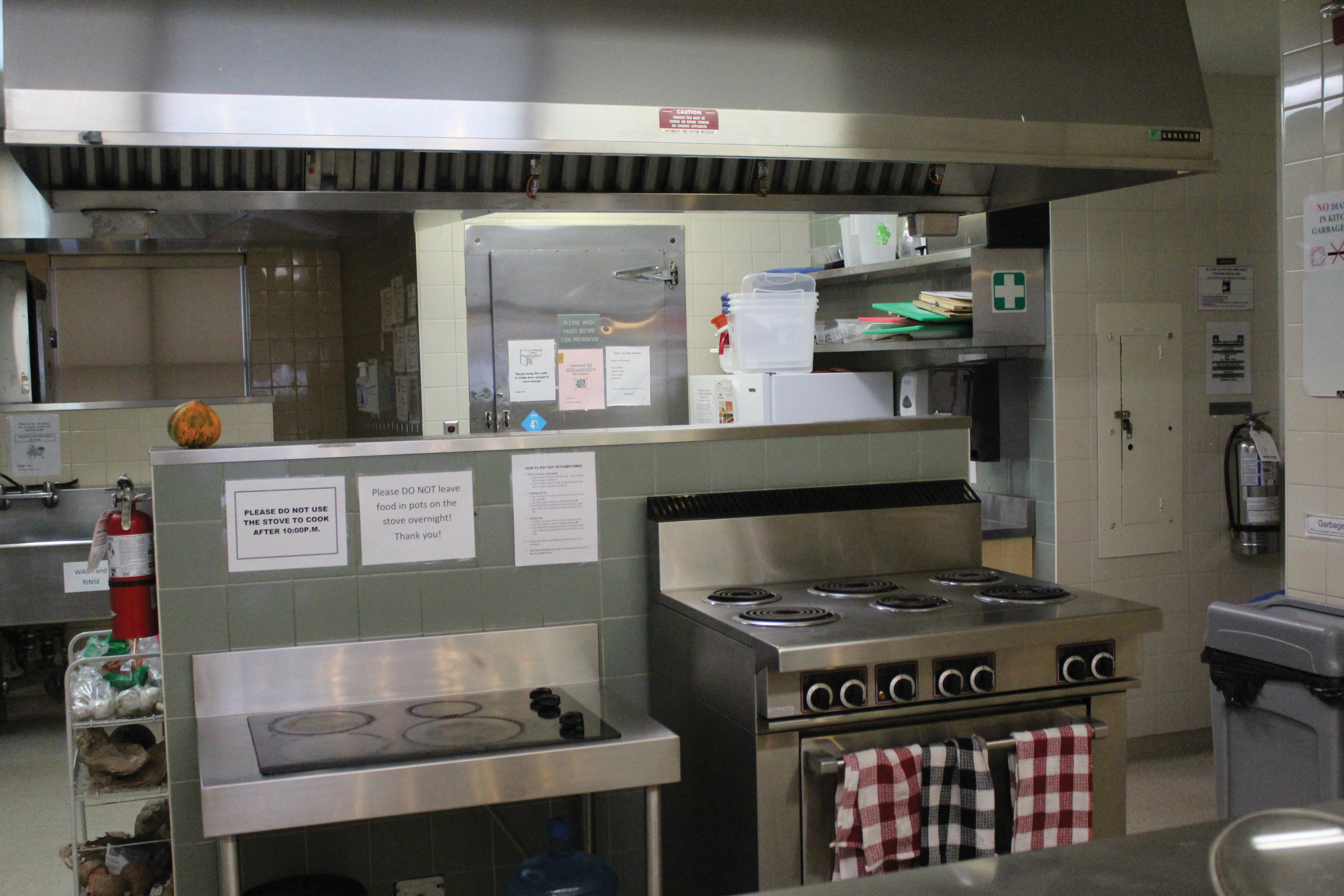
But Rabeena and her coworkers have a few things to say about the Interval House kitchen. It’s outdated and the years of daily use have taken their toll. Plus, according to Rabeena, it’s in desperate need of a new stove. “Every time I go into that kitchen, the first thing I see is that stove. It’s not the prettiest thing, and I wonder, is it even safe to turn that thing on? That stove has got to go!”

Thankfully, Avnet has committed to raising the money needed to purchase a new stove as part of our upcoming kitchen renovation. They’ve already started fundraising through internal raffles and they’ve got a few other ideas up their sleeve! Plus, Avnet Cares—an employee-led volunteer initiative that supports employees who are making a difference through hands-on and skills-based volunteerism—will match some of the money raised.

“When we had the opportunity to see some of the programs, especially the BESS program, I thought that it was great for a shelter to not just provide a safe place, but to actually help the women start a whole new life and support them through that entire process, that’s what really drove us to get involved. We feel like not only are we contributing, but we can also help [the women] get to a better place.”

Virginia Rock: A lifetime of caring for the disadvantaged

By | News

By Neil Sinclair, Trustee, Estate of Virginia Rock 

A friend of mine for many years, Virginia Rock spent her life in passionate support of those disadvantaged and displaced members of our society.

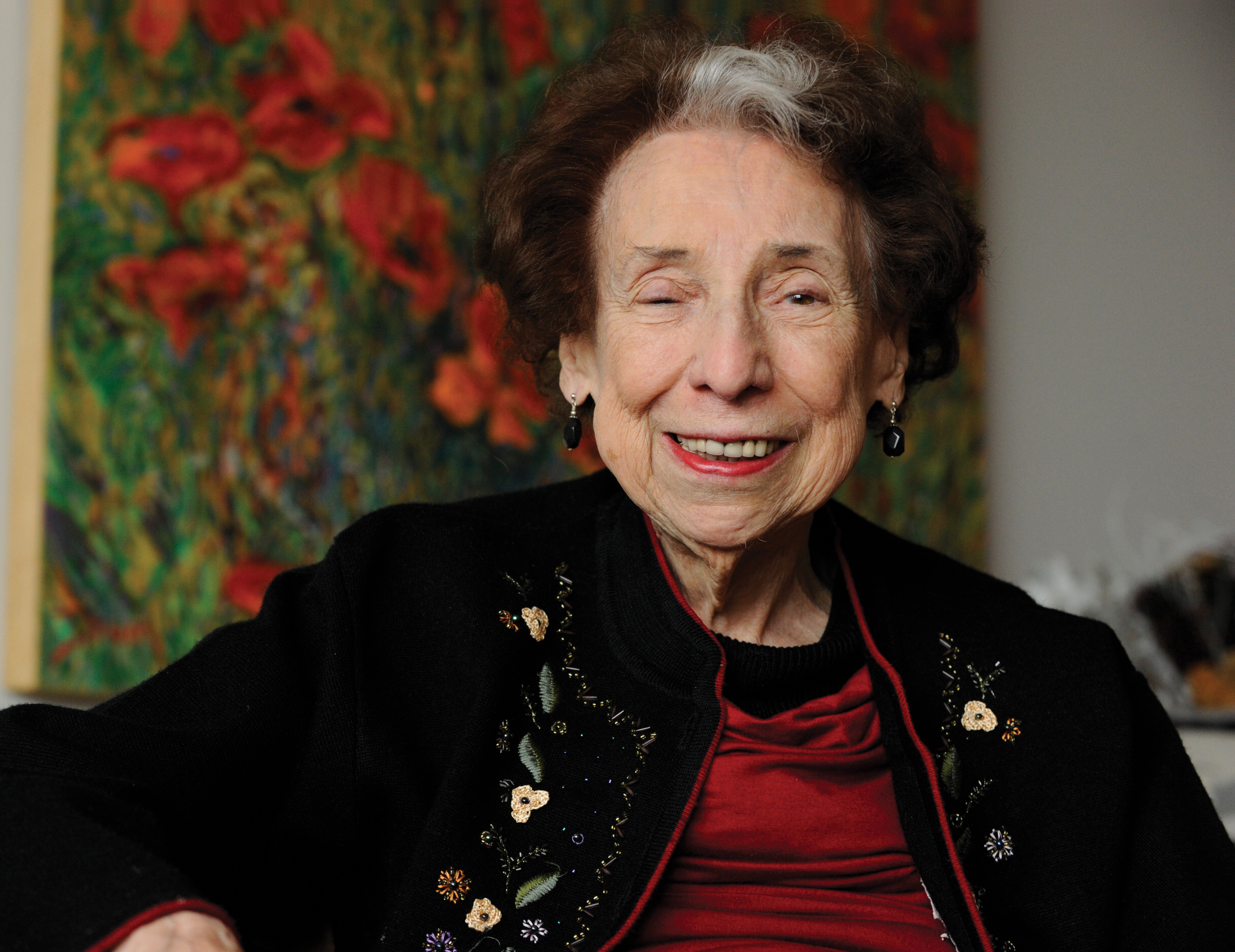
A devotee of English and American literature, Virginia was born in Michigan but moved to Toronto to teach at York University in 1965. Known as an inspiring role model for young women in a male-dominated academic setting, Virginia founded the Women’s Studies program at York.

Virginia came across Interval House many years ago, while writing an article summarizing her studies of displaced people. What she loved most about Interval House was that they offer more than a “handout”. Instead, they work to help integrate women back into society who often have nothing but the clothes on their backs.

Known as a humanist and an endless “giver”, Virginia was always willing to help people in any way she could. In her later years, Virginia served as President of the Ulyssean Society, a group I also belong to, dedicated to lifelong learning. During her time as President of the Society, she always ensured Interval House got a yearly donation during the holiday season.

On November 17, 2015, Virginia passed away at the age of 92. It did not come as a surprise that Virginia had planned to continue her legacy of caring for the disadvantaged through a gift in her will to Interval House. Her generosity will continue to nurture families through programs and services that provide emotional support, practical help and life skills to break the cycle of violence.

Kitchen Renovation Desperately Needed

By | News

The Interval House Kitchen is truly the heart of our home. It’s a place where moms and kids come together to share a meal, as well as laughter and tears. Used at least three times a day to cook meals for up to thirty people over the last 10 years, our “heart” is in desperate need of some tender loving care!

When we moved into this house 10 years ago, the kitchen received some cosmetic and accessibility upgrades, but the foundation and many of the appliances were left untouched. The existing walk-in fridge and freezer, along with our grease traps, are well over 50 years old. As you can imagine, they’re no longer in good repair.

The grease trap regularly overflows, damaging masonry and flooring—and spreading foul smells throughout the kitchen and program areas. The fridge and freezer break down frequently, creating food waste and increased expenses. Plus, our stove needs replacing.

Women and children fleeing domestic violence desperately need a solid foundation to rebuild their lives. Our kitchen forms the very centre of that foundation: for the women who cook the nightly meal, for the volunteer groups who occasionally come and cook for them, and for the children who come in search of nourishment.

That’s why our kitchen desperately needs an overhaul! Our goal is to significantly renovate the kitchen as soon as possible so that future families can truly enjoy the space and home cooked meals, just like the families that came before them.

The cost of a complete kitchen renovation will be $400,000. With care and maintenance, the new kitchen will last another 25 years or more! That’s 25 more years we can nourish women and chidlren along their journey of healing, with tenderly homecooked food and communal conversation. We think it’s worth it, and we hope you will too.

The 16th Day: International Human Rights Day

By | News

For 16 days, we have invited you to think about and share what you can do to help end violence against women and girls. We’ve talked about learning how to intervene when someone is experiencing abuse, we’ve discussed teaching children from a young age about the values of respect and equality, we’ve encouraged one another to consider volunteering and donating to women’s rights organizations, and more. The 16 Days of Activism Against Gender-Based Violence concludes on this, the International Human Rights Day. And though the campaign is coming to a close, we hope you will carry on the conversation about how everyone can be helpful in the effort to end the cycle of violence against women.

The International Human Rights Day is a day on which we are each invited to stand up for someone’s rights and foster a global culture of respect and dignity for all. After all, it commemorates the day in Paris in 1948 when the United Nations General Assembly adopted the Universal Declaration of Human Rights (UDHR) in response to the conclusion of World War II. This made official the fact that all humans are born free and equal — with the same basic rights. You may be familiar with this famous clause from the declaration, “Everyone has the right to life, liberty and security of person.”

Though it’s been nearly seven decades since the UDHR was drafted, we still witness inequality based on an array of characteristics such as race, gender, sexual orientation, religion and more. We see human rights violations every day right here at home and around the world. This is unacceptable and we can do so much better!

At Interval House, we stand up for basic human rights for all, without exceptions. We stand up for women who face violence at the hands of their partners — violence that stems from problematic gender stereotypes and a culture that still treats women as lesser than. We stand up for children who experience family violence and need love and understanding to heal. We stand up for people of colour who deserve the same open doors as everyone else. We stand up for social justice.

We are grateful that you stand with us too and we know that you will take your activism with you, beyond these 16 days, to help create a safe environment for women and girls. By banding together and continuing to discuss gender-based violence, we are reinforcing the notion that everyone deserves a life free of violence.

Navigating Family Law When Faced With Intimate Partner Violence

By | News

By: Kali Madej

It can be an overwhelming time when a woman begins her journey of healing at Interval House. One of the big things she may need to manage is navigating the family law system. Depending on the circumstances of a separating couple, such as their level of commitment, the living situation, and whether or not there are children involved, there are many aspects of family law in Ontario that impact a woman’s next steps once she has left her abuser.

Knowledge is power, and it’s crucial for a woman fleeing abuse to understand her legal rights and how she is protected by the justice system. It may seem challenging to understand, but there are many resources that can empower a woman to move forward confidently in her new life while still receiving what she’s legally entitled to. It’s important for a woman who has survived intimate partner violence to recognize that going through the legal process and keeping assets that belong to her is a right – not an option, and a way to take back control of her life.

Separation and Divorce:
Once a relationship is terminated and a couple separates, assets and property are divided between the two. Division of assets depends on the level of commitment in the relationship. Child and financial support, payment of family debts, and property division are all settled through a separation agreement – either an informal verbal contract or written agreement. Coming to a separation agreement can be challenging and in cases of domestic violence, it can be even more complicated. If a woman has fled a dangerous situation, how can she be expected to come to an agreement on dividing property?

There are alternate methods for devising a separation agreement that are helpful for survivors of intimate partner violence. The separation agreement can be handled through negotiation, mediation, collaborative law, or arbitration. If none of these methods are successful, going through the court system is the next option.

A mediator (usually a social worker, lawyer or psychologist) can act as a bridge between the separating partners and help in reaching an agreement to divide assets fairly. Mediators do not make decisions. Rather, they support the process of arriving to agreeable terms. However, a survivor of intimate partner violence may want to consider other options, as the trauma of facing her abuser may discourage a woman from pursuing her rightful assets.

Arbitrators (usually a lawyer, child psychologist, or former judge) play a similar role to mediators – except they do have the power to make decisions on behalf of the couple. Because arbitrators have training in family law and domestic violence, survivors can feel confident in their involvement and decision-making. Still, arbitration does involve facing the abuser in a confined environment, and so survivors of abuse should be aware of this during the decision-making process.

If the arbitration process is not an option or is unsuccessful in reaching a separation agreement, survivors can go through the court system. Many perceive this process to be time consuming and costly, but there are many options for women who have fled violent relationships and many cases are resolved within a short time frame.

Legal Aid Ontario provides assistance in getting lawyers for women with low income. By calling 1-800-668-8258, women can speak to a lawyer for two hours for free. Counsellors at Interval House can act as advocates for women in court and provide moral support and presence, reminding all survivors that they do not need to face their abusers alone. Beyond Legal Aid Ontario, the Barbara Schlifer Clinic and Luke’s Place are organizations that provide support to abused women specifically. Both organizations offer a range of services, including legal support and family court support.

Leaving an abusive relationship is hard enough and the Ontario legal system may seem overwhelming. But all survivors of intimate partner violence have already proven their strength and resolve by leaving. They have the resiliency to make it through this stage too. Women leaving abusive situations are entitled to what is rightfully theirs, and Interval House is committed to helping them through every stage of the difficult process.

Join Interval House in Taking Action Against Gender-Based Violence

By | News

Today marks the International Day for the Elimination of Violence Against Women, and the beginning of 16 Days of Activism against Gender-Based Violence.

Women have progressed leaps and bounds since first being recognized as “persons” in Canada in 1929. We can vote, we can lead corporate and non-profit organizations, we can hold public office, we can play professional sports, and we can mobilize to demonstrate against injustice. But gender discrimination, inequality and patriarchal values persist and they lead to the very real and current problem of violence against women (VAW).

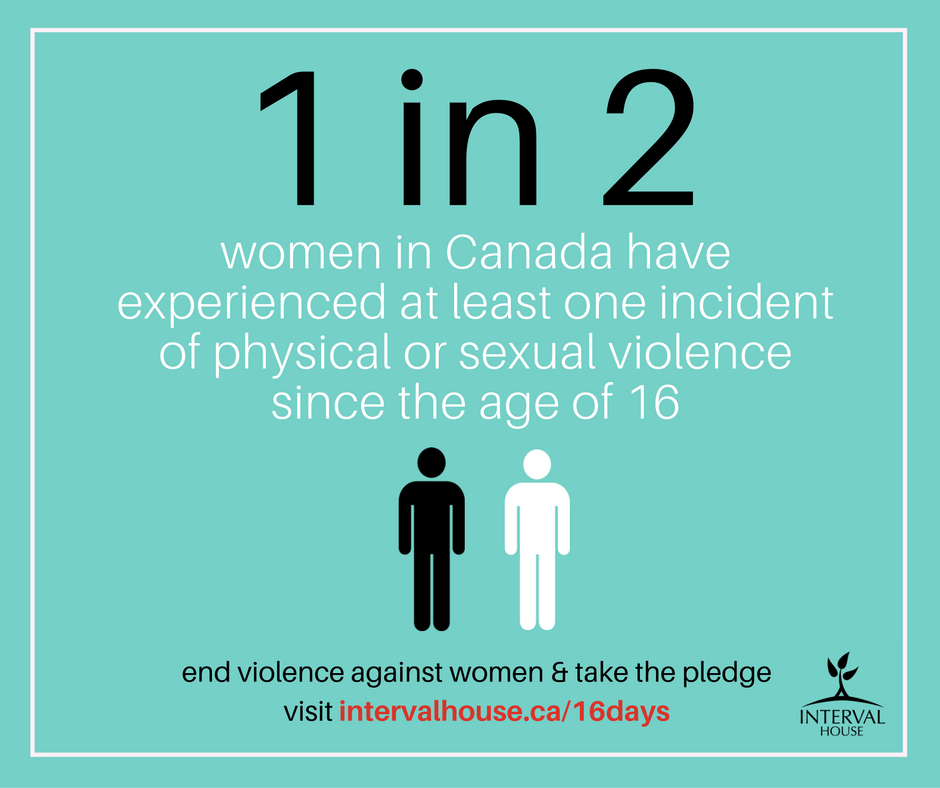
One in two women in Canada has experienced at least one incident of physical or sexual violence since the age of 16.1 That’s fifty percent of all Canadian women! Can you imagine what that statistic would be if it encompassed emotional abuse too?

If you think that VAW is an individual or private problem that doesn’t concern you, it’s time to take a closer look at the issue. Ban Ki-moon, UN Secretary-General, articulated it best when she said, “Violence against women and girls is a human rights violation, public health pandemic and serious obstacle to sustainable development. It imposes large-scale costs on families, communities and economies. The world cannot afford to pay this price.”2

You see, when a woman experiences intimate partner violence, sexism, harassment, or discrimination of any kind, it will have serious impacts on her mental and physical well-being. Those impacts ultimately interfere with her ability to live and to work. It impacts her ability to realize her full potential.  It affects the level of care she can give to her children and loved ones. From there, the butterfly effect sets in and the woman’s children and her community live with the consequences of the violence she was subjected to.

That’s why it’s so important to take action against gender-based violence. The 16 Days of Activism campaign is a call to action. It encourages you to consider the ways you can help eliminate VAW through tangible actions — because actions matter.

Here are some ideas about how to join in the crusade to end VAW once and for all:

  • speak up when you witness sexist behaviour or violence
  • volunteer for a local women’s organization
  • donate to VAW organizations
  • engage your friends and family in discussions about VAW
  • challenge dated concepts about gender roles

Do you have other ideas about how you can help? We’d love to hear from you! Follow our 16 Days of Activism campaign on social media and share your pledge to work to end VAW with the hashtag #16DaysPledge. You can find us on Facebook at @IntervalHouseTO, on Twitter at @Interval_House, or visit our website at https://www.intervalhouse.ca/16days.

Let’s join together as allies to end gender-based violence for a more harmonious, just and equitable world.


1 http://www.canadianwomen.org/facts-about-violence

2 http://www.un.org/en/events/endviolenceday/

BESS Sets Women Up for Success

By | News

Women’s empowerment – the centre of our support services

Interval House takes a holistic approach to the goal of ending violence against women by placing women’s empowerment at the centre of its support services. The fact of the matter is that a woman who escapes abuse is not only healing wounds, she is rebuilding her life from scratch.

After surviving unspeakably traumatic experiences, women who leave abusive relationships will encounter a series of hurdles on the road to peace, healing and independence. The greatest challenges—psychological, emotional and practical effects—often stem directly from the abuse they’ve endured. Many survivors may have no savings, unstable housing, and low self-esteem; they might be isolated from friends and family, experience feelings of powerlessness, and lack essential workplace skills.

Decades ago, Interval House staff saw the need for a program that addresses the unique barriers that abused women face when seeking employment. They heard from survivors that financial dependence was one of the reasons women stayed with their abusers. The path forward was clear: women needed more than an emergency shelter to break the cycle of violence for good. The question was: how to get there?

The BESS program (Building Economic Self-Sufficiency)

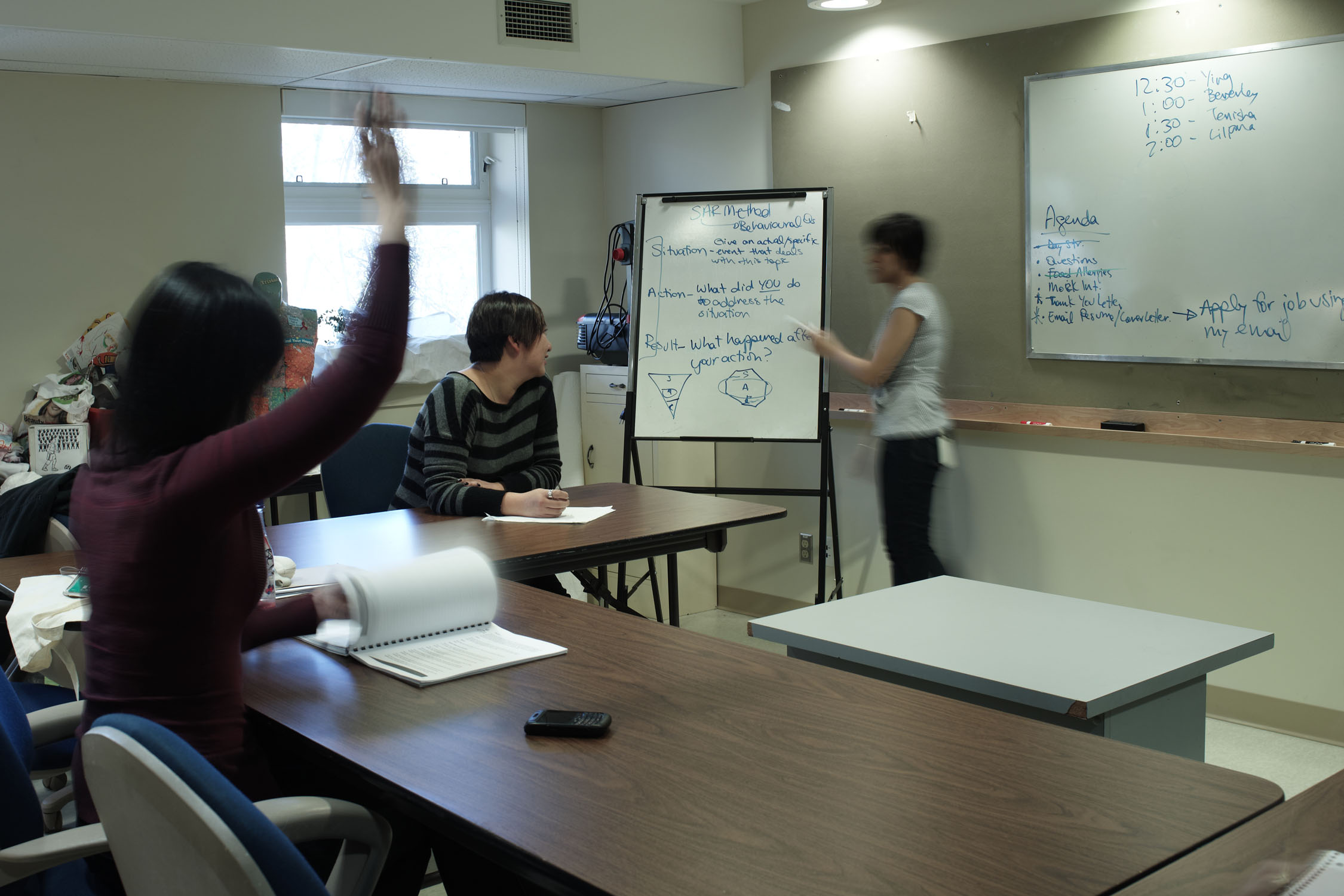
In 1998, the BESS program (Building Economic Self-Sufficiency) was born to help address this complex problem and continues to evolve to maximize the long-term impact on the lives of women and children who escape abuse. The program allows women to discover (or often re-discover!) their skills and competencies; they learn to write a resume and cover letter, conduct a job search, prepare for an interview and develop life skills like doing taxes and balancing working with parenting.

BESS continues to reflect the culture of innovation at Interval House, a modern trailblazer in the shelter movement. The program is built upon the belief that when women leave Interval House they must be able to achieve financial security, a home in a safe neighbourhood and the chance to develop a sincere belief in a brighter future ahead.

BESS BY THE NUMBERS – IN 2015

  • 39 women graduated from the BESS program
  • BESS women wrote 58 resumes and dreamed big with 39 vision boards
  • 69% of BESS graduates found stable jobs
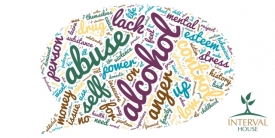
Word cloud

Myth-Busting: What are the causes of domestic violence?

By | News

Earlier this year Interval House posed a question to Ontarians through an Angus Reid Omnibus Survey to uncover some of the common myths, attitudes, ideas and misperceptions about the causes of domestic violence.

The most common responses appear in the word cloud below.

Some words jump out right away: “alcohol,” “abuse,” “control,” “anger,” “self,” and “lack.” Words like “mental,” “esteem,” “stress,” “history,” “power,” “money,” and “drug” are also pretty common.

But when we start to scratch the surface, we discover there’s more going on than most people realize.

So for instance, look at the commonly held opinion that abusers are violent because they’re out of control when they’re drunk or high. Is it true?

FALSE: The relationship between substance abuse and domestic violence is complicated.

Just because there are many domestic abusers who also abuse substances, and vice versa, doesn’t mean that one causes the other. Abusive partners may be more prone to substance abuse and substance abusers more prone to partner abuse. But the most important reason why men abuse is that they think it’s acceptable to do so.

If you’d like to read more about the common myths that surround domestic abuse, you’ll find a 5-part series of blog posts here:

Part 1: What are the causes of domestic violence?

Part 2: Does substance abuse cause domestic violence?

Part 3: Does mental illness or anger cause domestic violence?

Part 4: Does a history of childhood abuse cause abusive behaviour?

Part 5: Is domestic violence about power and control?

Translate »