Category

News

Word cloud of reported factors contributing to abusive behaviour

Is domestic violence caused by mental illness or anger?

By | News

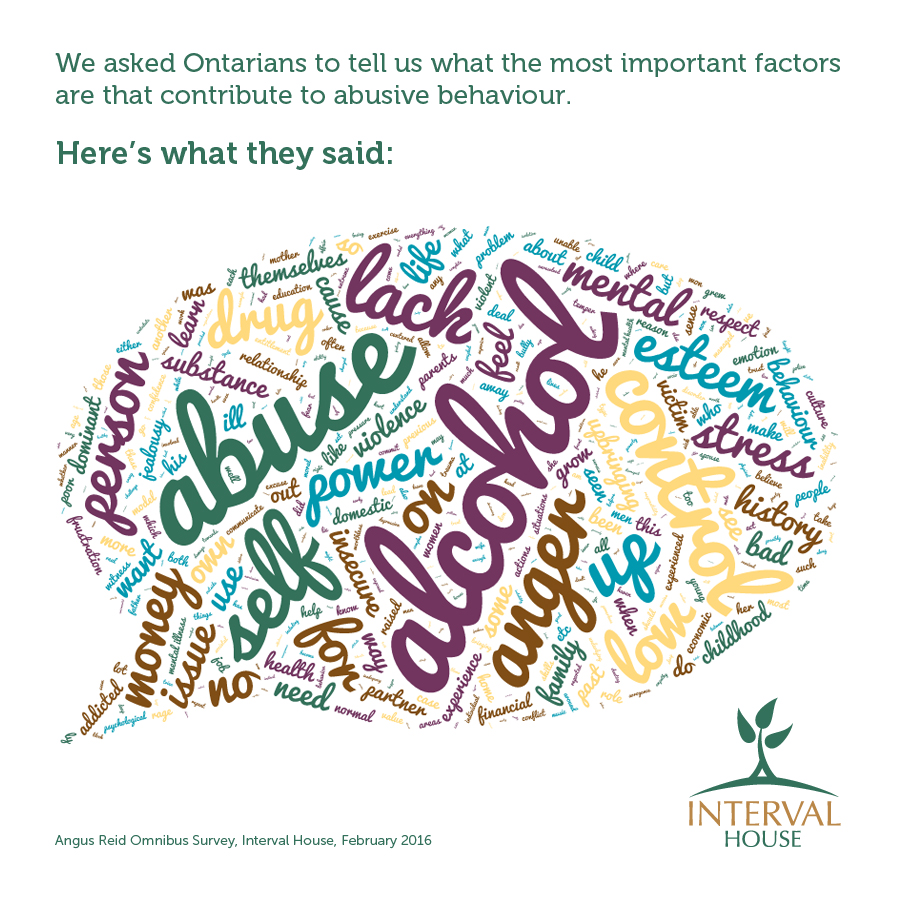
In February of this year, Interval House posed this question to Ontarians through an Angus Reid Omnibus Survey: “What are the most important factors that contribute to abusive behaviour?” We let them answer in their own words and used the most common responses to make a word cloud. Each week for the next month, we’re addressing a common attitude about the causes of domestic violence to investigate: is it true? Or is it a myth? In this post, we answer: do mental illness or anger management issues cause domestic violence?

When we asked Ontarians about the causes of abusive behaviour, some of the common words that came up were “anger,” “stress,” and “mental.”

This is another commonly-held belief: that abusers have mental health issues or don’t know how to control their anger and this is why they abuse. Is this true?

Mental Health & Domestic Violence

It’s common to think of abusers as mentally ill people in need of support. There’s not much research available on this topic that says definitively one way or the other if this is true. Still, this may sometimes be the case: that an abuser is also struggling with mental health issues. But the reality is that mental health and domestic violence need to be treated separately.

Last week, we talked about addiction and substance abuse, and how an abuser who’s working to stop abusing substances won’t automatically stop perpetrating violence.  The same goes for mental illness: an abuser who is struggling with mental illness won’t necessarily stop their violent behaviour if they seek help for their mental health.

Mental health is an important and often stigmatized issue, and it’s important for people affected by mental illness to receive the care and support they require. But mental illness isn’t an explanation or excuse for domestic violence.

Violence in intimate relationships is still caused by a belief that one partner is entitled to power and control over the other. As the National Domestic Hotline writes: “If your partner has a mental illness and is abusive towards you, it’s important to keep in mind that the mental illness and the abusive behaviors need to be handled separately by the abusive partner. It is the abusive partner’s responsibility to seek out support and create their own plan for managing their mental illness and be accountable for their abusive behavior.”1

There’s another link between mental health and domestic violence that we should mention: the mental health implications on survivors of violence. Domestic violence often leads to survivors developing mental health issues. And people struggling with mental illness are more vulnerable, and so are more likely to experience domestic violence.2 It’s important to think about this correlation when we talk about mental health and domestic violence too.

Anger Management & Domestic Violence

On a related topic, many people think of domestic abusers as people with violent tempers.  The idea here is that if they would just learn to control their bad temper, they would be able to stop the abuse.

Anger itself can actually be a healthy emotion when expressed properly.

But people with “anger management” issues struggle to express anger in a way that’s healthy and appropriate. If abusers have anger management issues, then it’s implied that they don’t have a choice – they can’t help themselves from becoming violent and flying off the handle.

The problem with this idea is that abusers are often strategic and purposeful in their violence. Domestic violence is a choice, one that is often planned and strategic on the part of the abuser. Abusers have specifically targeted their intimate partner as the recipient of their violence. Time and time again, we see abusers who are high-functioning and social in other parts of their life – charismatic celebrities, popular politicians, respected community members – who behind closed doors, terrorize their partner.

Domestic violence is meant to “control, intimidate, and subjugate another human being.”3 In contrast, people with anger management issues aren’t able to control the target of their anger, and are less strategic in directing their rage.

This isn’t to say that some abusers don’t have anger management issues, but rather that it’s not one and the same.

And again, the issues need to be treated separately. For this reason, many anti-violence organizations advocate for programs for convicted abusers that deal with domestic violence specifically, rather than general anger management programs.

Stay tuned for the next post in our myth-busting series, where we tackle the question: does a history of childhood abuse cause abusive behaviour?

Sources:

  1. http://www.thehotline.org/2015/05/abuse-and-mental-illness-is-there-a-connection/
  2. http://www.medicalnewstoday.com/articles/254475.php
  3. http://www.counselcareconnection.org/blogs/8/Is-it-Anger-or-Abuse.html
Word cloud of reported factors contributing to abusive behaviour

Does Substance Abuse Cause Domestic Violence?

By | News

In February of this year, Interval House posed this question to Ontarians through an Angus Reid Omnibus Survey: “What are the most important factors that contribute to abusive behaviour?” We let them answer in their own words and used the most common responses to make a word cloud.

Each week for the next month, we’re addressing a common attitude about the causes of domestic violence to investigate: is it true? Or is it a myth? In this post, we answer:

Does substance abuse cause domestic violence?

When we asked Ontarians what the most important factor was that contributes to someone being abusive, “alcohol” was the word used the most. “Drug” and “substance” were also common words used in responses.

This is a common belief: that abusers are violent because they’re out of control when they’re drunk or high. Is it true?

FALSE: While the belief that substance abuse causes domestic violence is a commonly-held opinion, it’s not supported by fact.

The reality is, the relationship between substance abuse and domestic violence is more complicated.

The idea that an abuser is “out of control” when he becomes violent towards his partner, is actually usually unfounded. A study showed that “the average amount of alcohol used prior to most episodes of intimate violence is often far less than imagined – usually about an ounce” (equal to a glass of wine or beer).1

It is true that there are many domestic abusers who also abuse substances, and vice versa? Research has shown that about half of the men in batterer intervention programs appear to have substance abuse issues, and half the men in substance abuse programs have battered an intimate partner in the past year.2

But this isn’t a matter of causation: just because both things often happen at the same time doesn’t mean that one causes the other.

The thing is, if domestic violence was caused by an abuser’s use of drugs and alcohol, then the violence should stop when they stop drinking or using drugs. But this usually isn’t the case.

Studies have shown that substance abuse might intensify the frequency or severity of violence for some abusers.3 For others, using drugs or alcohol might be used as an excuse for becoming violent.4 And for others, both their abuse of drugs and alcohol and their domestic violence might manifest from an underlying need for power and control.5

The reality is that “the relationship between SA [substance abuse] and IPV [intimate partner violence] is strongest for those men who already think IPV is appropriate in certain situations.”6 So, while abusive partners may be more prone to substance abuse and substance abusers more prone to partner abuse, the most important reason why men abuse is that they think it’s acceptable to do so.

While it’s not the cause of domestic violence, substance abuse is still a deeply related issue and a serious health problem. And it’s not only common amongst abusers: it’s also very common for survivors of violence to abuse alcohol or drugs. There are a couple of reasons for this.

For one, women struggling with addiction may be more marginalized and have less power and economic resources, making them more vulnerable to violence and less able to break free of abusive relationships.

On the other hand, for women who have survived violence, abusing substances can be a coping mechanism to deal with the trauma of what they’ve experienced.

Stay tuned for the next post in our myth-busting series, where we tackle the question: does mental health, anger, or stress cause domestic violence?

Sources:

  1. http://www.vawnet.org/applied-research-papers/print-document.php?doc_id=1324
  2. http://www.vawnet.org/applied-research-papers/print-document.php?doc_id=1324
  3. http://www.vawnet.org/applied-research-papers/print-document.php?doc_id=1324
  4. https://www1.umn.edu/humanrts/svaw/domestic/link/alcohol.htm
  5. http://www.vawnet.org/applied-research-papers/print-document.php?doc_id=1324
  6. http://www.ncbi.nlm.nih.gov/books/NBK64441/
A crisis line worker sitting at a desk

Meet Shirin: Part 4

By | News

INDIVIDUAL COUNSELLING & CASE MANAGEMENT

Recently, we introduced you to Shirin, one of our long-time Women’s Counsellor Advocates. Each month, we’ll be shadowing Shirin to give you an idea of what a day’s work is like as a counsellor at Interval House.

When residents move into Interval House, they’re assigned a case manager – a staff member who will be their main counsellor, advocate, and point of contact for the duration of their stay. In last month’s post, Shirin started working with Lani* as her Case Manager. But Lani’s not the only women Shirin’s working with right now. Today, she has an individual counselling session scheduled with Patricia*, another woman in the shelter. Patricia has two young children, and Shirin is working with her to help her through the trauma of leaving an abusive relationship, but also getting everything in place to rebuild her family’s lives once they leave Interval House.

While they’re staying at Interval House, women need to schedule time to meet with their case manager once every week. Their case manager will help them apply for housing, social assistance, make referrals to other services like mental health professionals or ESL classes, and help them navigate the court system if needed. The weekly meeting is a chance to make sure that everything’s on track and to check in to see how the resident is doing, and if she needs further support. And outside of these scheduled meetings, there’s a Counsellor Advocate like Shirin on shift 24/7 to speak with any woman who just needs a listening ear.

When Patricia first moved into the shelter a couple months ago, she was reluctant to do individual counselling.

This isn’t uncommon. Shirin often sees women moving into the shelter who are initially reluctant to open up to a counsellor. Sometimes they want to keep everything private. Or maybe they’re scared that telling a counsellor what happened will get them in trouble legally.

“We try to make our environment so that they feel comfortable,” Shirin says. “We can’t force them to talk to us, but if they trust us, then they are more likely to open up.”

When Patricia first started working with Shirin, she was very frustrated and disappointed with her situation. But, over the course of the months she’s been at the shelter, she’s begun to open up more and more. She describes her experience participating in counselling groups as “empowering.” Shirin has helped her navigate the separation process from her husband, and has helped her find educational support for her two daughters who were struggling at school.

Individual counselling and case management is so important for women like Patricia because it allows them to go through their unique personal issues in detail.

All women living at Interval House have survived domestic violence, but the effects of violence are different for every woman. And knowing that she has someone with her helping her along her individual journey is often what a woman needs to be able to take those first steps to independence.

For the next few months, we’ll be giving you a glimpse into Shirin’s work, taking you step-by-step through a day in the life of a counsellor at Interval House. Stay tuned for the next part in our series, when we follow Shirin through a counselling group.

*Names and some details have been changed for safety and privacy.

A framed paining hun on a wall

Art Heals

By | News

If a picture is worth a thousand words, what is the value of a piece of art? Art in all of it’s varying forms has long been used by humans across all cultures to convey emotion, represent perceptions, cultivate self-growth, and tell stories. Art and experiencing art allow for human connection, emotional healing, and self-expression. It’s no wonder that expressive art is part of Interval House’s holistic healing approach for both women and children.

On February 11th, the pARTy Time Learning lab – an event series developed, designed and curated by Caroline Macfarlane and Morgan Mavis – threw its culminating event called “Hang in There Baby”, to benefit Interval House.  In the dead of winter, Hang in There Baby transformed the OCAD U Student Gallery into a tropical oasis to rejuvenate and inspire attendees through print, textiles, and performance. The gallery featured a greenhouse as a wellness centre, a swing installation set to the backdrop of youth videos, and a variety of art pieces such as paintings and digital prints to inspire positivity, create good energy, and uplift guests.

The initial idea of the event was sparked after Caroline spent many hours as visitor in a local hospital, and was struck at how clinical and other spaces would benefit from colour as a mood and energy enhancer. Artists were approached to create a piece with one simple instruction – create work that would bring joy to a space that would benefit from positive energy.

Post-event, the pieces were donated to Interval House to adorn the walls, and serve as a constant reminder of the beauty in happiness and positive energy, and the encouragement to push forward and thrive. The artists created a range of paintings and prints, using varying techniques and colours. Stunning and vibrant bright hues dominated many of the works of art, but there were many serene and calming colour palettes used as well.

Once the event concluded, Caroline and Morgan visited Interval House to curate the shelter and determine where the artwork would rest. Touring the shelter, they visualized where residents may need the extra reminders of joy and lightness as they continue on their journey of healing.


Thanks to the Hang in There Baby artwork, our simple staircase corridors have been reimagined into inspiring and illuminated spaces. Plain hallways have become the perfect home for kaleidoscopes and mosaics of lively colours.

Interval House graciously thanks the Hang in There Baby team and the talented artists for their contribution to the hope and peacefulness of our shelter. If a picture is worth a thousand words, a work of art is priceless – as the magnitude of emotional encouragement can’t be measured.

Wood gavel and block

Navigating the criminal justice system for domestic violence

By | News

Domestic violence is a criminal offence. This means that abusers should be charged and prosecuted for violence against their partners.

But for a survivor of domestic violence, going through the criminal court system may be one of the most stressful and intimidating events she will endure. She may fear that her partner will seek revenge if he is charged. She may not be able to afford legal advice, and not know where to begin.

But there are many supports in place for women in abusive situations who are navigating the criminal justice system. Here’s some information about the system and the help that’s available.

Mandatory charging

Ontario has a mandatory charging policy, which means it’s up to the police to lay charges, not the person experiencing violence. If the police are called to a domestic violence situation, the police officer must lay a charge against the abuser if reasonable grounds exist. Women may not have the charges dropped. The Crown prosecutor then prosecutes the case through the courts.

On the surface, the mandatory charging policy may seem like a good step in helping those who are experiencing domestic violence. However, while it intends to demonstrate the seriousness of domestic violence, it does not always work in the abused person’s favour.

Domestic violence is a gendered issue that disproportionately affects women. In the vast majority of domestic violence cases, it’s those who identify as women who experience violence perpetrated by men.

When a police officer arrives at the scene of a domestic disturbance, they are trying to determine who the dominant aggressor is. As a result, sometimes women who may be defending themselves against their abuser may be unfairly arrested, and charges can be laid against both the abuser and the person being abused.

In addition, the decision whether or not to lay charges is at the discretion of the police officer, which means that whether “reasonable grounds” exist is still open to interpretation. In many cases, this may mean that charges are still not laid despite the mandatory charging policy.

For those experiencing domestic violence, it can be very important to document every instance of violence if possible to do so safely. If it’s safe for a woman to do so, writing down the date, the details of what happened, as well as any witnesses that are present, can help the Crown attorney to better prosecute the case.

Obtaining legal representation

Finding legal representation can be a big challenge. A woman living with abuse may not have the financial means to afford a lawyer. She may fear having to represent herself in court, be reluctant to put her children through the court process, be faced with filling out complex legal documents, and be forced to face her abuser in court with no support. Newcomer women may also fear that they or their partner will be deported.

But there is help available. At Interval House and other shelters, there are Counsellor Advocates to help support women navigate the court system. Our shelter helps women obtain Legal Aid services through Legal Aid Ontario, and refers women to agencies like the Barbra Schlifer Clinic and Luke’s Place for representation and support.

Restraining orders:

One option for women in abusive relationships is to get a restraining order (also called a protective order) against the abuser. A restraining order prevents an abuser from contacting a woman. It provides a list of rules that the abuser must adhere to, such as:

  • staying away from the woman
  • not contacting her by phone, email, or other means
  • not coming to her home
  • not coming to her workplace
  • staying away from her children’s school
  • staying away from places she visits often.

However, getting a restraining order is not a guarantee. Applications for restraining orders can be denied, and even when in place, it’s not a promise that the abuser won’t break the law. Abusers can be cunning, and can violate the restraining order in ways that make it difficult to collect evidence and prove that the restraining order has been violated. While it’s not required to have a  lawyer to apply for a restraining order, it is recommended to have one.

Navigating the criminal courts

Ontario has a Domestic Violence Court specifically for domestic violence cases. Police, Crown attorneys, the Partner Assault Response program, and Victim/Witness Assistance program staff and other community agencies all work together to provide support and prosecute these cases successfully.

However, going through the criminal court process can be extremely intimidating for survivors of domestic violence. A Family Court Support Worker will help women navigate the process and provide support. They will provide information about the court process, help her prepare for court proceedings, and even go with her to court dates. To ensure her safety and that she can get to and from court safely, they will also help her put together a safety plan. They also provide referrals to other community services.

The courts have a Victim/Witness Assistance program, which can support her through the process, prepare her for the court date, provide emotional support and other services. The Child Victim/Witness Assistance program is available to help children who have been abused or witnessed domestic violence to navigate the court process.

When it comes to domestic violence, navigating the criminal justice system isn’t easy. Calling the police, getting a restraining order or going through the criminal court system a personal and difficult choice for survivors of domestic violence to make. Whatever a survivor’s decision, there are supports available to help her.

Image credit: Brian TurnerCreative Commons Attribution 2.0

Intake worker in the interval house kitchen

Meet Shirin: Part 3

By | News

INTAKE

Recently, we introduced you to Shirin, one of our long-time Women’s Counsellor Advocates. Each month, we’ll be shadowing Shirin to give you an idea of what a day’s work is like as a counsellor at Interval House.

Today, during Shirin’s shift, she’s completing an intake with a new resident.

“Intake” is what we call the process of accepting a new resident into the shelter. It involves a pre-screening over the phone, arranging the details of a woman’s move into the shelter, and more detailed interviews shortly after the woman moves in.

A woman (we’ll call her Lani) called the crisis line in the early hours of the morning yesterday. Often, women call Interval House and a counsellor like Shirin can help them plan a safe time to leave their abuser – it could be hours or days later when the best time arises.

But for Lani, this wasn’t an option. She had already fled from her home with her two daughters. Not knowing where else to go, she had gone to her local neighbourhood centre, where she got the number for Interval House.

After speaking with Lani on the phone, Shirin gave her the information she needed to move into the shelter, and an hour later, here she and her daughters were, at our front door.

The girls didn’t even have any shoes or socks on. “There was no time,” Lani tells Shirin. “I was so scared.”

Shirin brought Lani and the girls inside, and the first step was for them to sit down and do a basic intake. Shirin got copies of their IDs, she explained the house rules like respect and inclusion, and asked Lani some basic questions about her history. Then she took them on a tour, giving them keys to their new bedroom.

Because the family was still dealing with the shock of what had happened, they only went through the basics yesterday. Within the first three days, though, all new residents need to do a more detailed intake interview. Lani feels ready today, and so Shirin meets with her to go through the full process. She asks her questions about her past, about the abuse. It’s difficult to speak about, but for Shirin to be able to best help her, she needs to know what Lani’s been through and what kind of supports she needs.

Shirin will now become Lani’s case manager for the remainder of her stay at Interval House.

Together, in this first meeting, they put together a case plan, determining what the family needs and how Shirin can help them achieve these needs.

If they need legal services, Shirin can help them with referrals and getting Legal Aid; if they need financial assistance she can refer them to the right place. For any of the services Lani needs for her daughters, such as school, daycare, or counselling, she’ll meet separately with Elizabeth, one of our Children’s Counsellor Advocates.

The first few days of Lani’s stay might feel like a whirlwind. But she has plenty of time during her stay at Interval House to step back and process what’s going on. Most women stay at our centre for 3-4 months so Lani and Shirin have lots of time still to make sure that she’s equipped to start her new life, free from violence.

For the next few months, we’ll be giving you a glimpse into Shirin’s work, taking you step-by-step through a day in the life of a counsellor at Interval House. Stay tuned for the next part in our series, when we follow Shirin through an individual counselling session with a new resident.

Interval House Gratitude report 2015

Grateful for Your Support in 2015

By | News

The 2015 Gratitude Report is here!

With spring upon us at Interval House, we’re looking forward to the new season. But before we move ahead, we want to take some time to reflect on all that made 2015 a fantastic year! The 2015 Gratitude Report is now available for you to see the impact of each of your contributions at Interval House.

This year’s Gratitude Report is inspired by the John S. C. Abbott quote, “But suddenly like the transformations of the kaleidoscope there came another and a marvellous change.” Like a kaleidoscope’s changing and shifting colours, many women’s lives have been transformed this year at Interval House through your friendship. As you read the report, you can see how your love and support has brought about many “marvellous changes” at Interval House this year.

If you want to learn more about how you impacted the lives of women and their children at Interval House, please click here to read the 2015 Gratitude Report.

A crisis line worker on the phone

Meet Shirin: Part 2

By | News

CRISIS PHONE LINE

Recently, we introduced you to Shirin, one of our long-time Women’s Counsellor Advocates. Each month, we’ll be shadowing Shirin to give you an idea of what a day’s work is like as a counsellor at Interval House.

Today, Shirin is the counsellor on-shift, meaning that she’s the one monitoring our crisis phone line.

Counsellors are always on shift 24/7, one in the daytime, one in the evening, and one overnight. This means that women in distress can call Interval House at any time, day or night, for help and advice. The on-call counsellor also helps new women to move in, and is available as a listening ear to any of the women already living in the shelter.

Shirin’s on the morning shift today and she receives her first call of the day: it’s a woman (we’ll call her Amy) who wants to leave her abuser, but she’s not sure yet. Amy needs help with safety planning – to make sure she can leave at a time that’s safe for her and her kids – but she also has some questions about what to expect at Interval House.

“Will we have to share a room?”

“Will you help with my kids? They need to go to school.”

“Will you help me find a job? I’ll need help finding housing afterwards too. Can you help with that?” 

These are the questions Shirin often hears. “Especially for women who are coming to a shelter for the first time, they don’t know what to expect,” she says. “There’s a myth that shelters are bad places. They want to know what it will be like and that it’s the right choice. We help them understand that it’s the right choice for them and their children to come here, that we can help them.”

Sometimes, women who call aren’t in any state to ask these questions though. Shirin remembers a particularly hard call she received recently. The woman called from the hospital. Her abuser had stabbed her, over and over again, but she survived. She called Interval House, and just wanted to know that she and her young children could be safe at our shelter.

Often, women don’t want to report their abuser to the police

Shirin helped her to move in safely.  “When she moved in, her injuries were even worse than we expected,” Shirin says. “But she didn’t want to report it to the police.” This is something that Shirin sees often: women don’t want to report their abuser to the police, because they think the danger will only intensify if he knows she reported the violence.

“Women think that it will make the abuse worse, that their partner will follow them more, if they report to the police,” Shirin says. “Sometimes, their partner has told them that he’ll kill her if she calls the police. That he’ll harm her children, or throw acid on her face.”

And, for newcomer women without status in Canada, she adds: “They’re scared they’ll be deported if they report. So they come to Interval House, but they don’t press charges. And we respect their wishes. We can’t force women to do anything.”

Now, on the call with Amy, Shirin begins to ask her the standard intake questions: Is the abuser an intimate partner? Does she live far from the shelter? How big is her family? What can she tell Shirin about the abuse she experienced? Shirin hopes that she can give Amy and her kids the help they need, so that they can make the move to start fresh and rebuild their lives. That’s her goal every day.

For the next few months, we’ll be giving you a glimpse into Shirin’s work, taking you step-by-step through a day in the life of a counsellor at Interval House. Stay tuned for the next part of our series, when we follow Shirin through the intake process with a new resident.

pankcake breakfast

International Women’s Day Reflection

By | News

It’s been said that the kitchen is the heart of the home. It’s not simply a place to prepare food – it’s a place to gather, a place to unwind, a place to enjoy a delicious meal and fulfilling conversation, an opportunity to refresh the spirit in the presence of good company. The kitchen at Interval House is no exception. Bustling with activity, the kitchen is full of life and experience, as women and children prepare and enjoy nutritious and delicious meals.

Historically, on March 8th, Interval House’s kitchen takes on a whole new theme of celebration. Bright and early in the morning, the kitchen is lit up with the sound of eggs cracking, of pancakes cooking on the griddle. The aroma of fresh bacon frying fills the air, tantalizing the nostrils of the residents as they wait patiently for breakfast to be served. This is not an everyday breakfast at Interval House. One of our counsellors heeds the call of her early alarm to begin prepping the decadent breakfast, all in celebration of International Women’s Day. It is often the first time residents have celebrated this global event, and a significant milestone to honour on their journey of freedom from violence.

International Women’s Day is celebrated worldwide, to honour the social, economic, cultural and political achievement of women. It’s also a day to acknowledge the work that still needs to be done to make gender equality a reality. Living in a developed and prosperous country like Canada, it’s easy to lose sight of how much work is still to be done to achieve this ultimate goal.

The World Economic Forum has predicted that gender parity will not be realized until 2133. In Ontario alone, the gender wage gap is 26% for full-time workers – meaning, for every $1.00 a man earns for his job, a woman doing the same job would earn $0.74 (Statistics Canada, 2011).

Inequality is not limited to just wage either. Women face gender-related issues worldwide, not only in the workforce, but also in the home, and in public.  We have made wonderful progress since the first formally recognized Women’s Day in New York City in 1909 – when women marched in the streets demanding shorter hours, higher wages and voting rights.

Still, as we share the celebration within the walls of Interval House, we are aware that violence against women persists as a major issue women face.

The statistics speak for themselves. At least one women is killed by her partner every 6 days in Canada (Statistics Canada, 2011). Each year, an estimated 362,000 children witness or experience family violence (UNICEF, 2006). Sadly, if these children are raised in an abusive household, the likelihood is that they will continue the cycle of violence in their own adult lives. Only 22% of victims of spousal violence report their abuse to the police in Canada (Centre for Research and Education on Violence Against Women and Children).

In light of these statistics, it’s a beautiful moment to celebrate the achievements of women worldwide, and the achievement of the women at Interval House for leaving their abusers and choosing to rebuild their lives. The bravery and strength of our residents inspires and serves as a reminder as to why International Women’s Day is such an important occasion to commemorate and celebrate. The more women’s issues are brought to light and the more we honour the brave women fighting for equality, the more women are empowered to follow suit and seek equality in all facets of their lives.

Our residents at Interval House may never tell their stories on a larger platform. They may never receive public recognition for their tremendous bravery. But they have made the conscious choice to walk away from their abusers and heal – and that is a truly amazing accomplishment that we hope all women facing violence in the home will make. We are thrilled to support women in their journey to health, happiness and self-sufficiency with a safe place to call home.

Back in the kitchen at Interval House, the slight sound of drip coffee passing through the filter is audible. The table is a mosaic of plates, cutlery, maple syrup, butter, milk, and cream. Excitement and positive energy are tangible in the air. Women and their children sit down to enjoy a meal today, as they do every day. But today, they formally celebrate International Women’s Day, many for the first time. In celebrating International Women’s Day, they honour themselves along with all women and take the moment to formally recognize their own strength amongst a community. The beauty of new beginnings.

Image credit: Sean MacEnteeCreative Commons Attribution 2.0

Pink orchids

How does domestic violence affect a woman’s career?

By | News

When a woman is living in an abusive situation, her home is often a dangerous and stressful place. But the impact of domestic violence on her career is an important factor often not talked about.

Domestic violence and the workplace

Working outside the home may provide some relief for women, but the abuser can often turn her workplace into an unsafe and stressful environment for her and her coworkers. Even though she may be physically away from her abuser, the abuser may still know where she works and stalk her. He may send abusive messages, show up at the workplace, or call her repeatedly. The abuser may also become violent during work time.

The domestic violence she’s living with may cause the woman to be distracted while at work, which negatively affects her job performance. Her productivity may be affected. She may also be late or absent from work often, all of which can mean she has a higher chance of losing her job.

What can employers and coworkers do?

If you suspect that your employee or co-worker is being abused, there are some things you can do to help.

1. Recognize the signs.

The first step is to understand the signs of abuse. The following are signs to look out for; but it’s important not to jump to conclusions. Someone can also show some of these signs if they aren’t in an abusive relationship.

  • Do you see bruises or cuts? Has your co-worker had broken bones, or sudden hearing loss?
  • Have you noticed that her job performance has been affected? Is she making more mistakes, absent or late more often, or having trouble concentrating?
  • Is she working late more often so she doesn’t have to go home?
  • Is she more anxious, depressed, or fearful?
  • Has she hinted about a troubled home life, or is she hesitant to talk about her home life?
  • Has she said she’s afraid of losing her job?
  • Is she dressed inappropriately for the season, such as wearing turtlenecks in the summer or heavy makeup?
  • Is she receiving unwanted visits or phone calls?
  • Is she receiving gifts or flowers at work after a suspected violent argument?

2. Talk to her.

Find a quiet time and let her know that you’re concerned for her, in a supportive and non-judgmental way. Tell her what you’ve noticed and stick to the facts, without trying to fix the situation. Ask her if she’s OK or if she’d like to talk. You’ll be showing your support in a way that is safe and comfortable for her.

3. Tell her you believe her.

Reassure her that you believe her and that the abuse isn’t her fault.

4. Don’t pressure her.

She may deny the abuse or be unwilling to talk about it. Continue to let her know that she can come to you anytime. If she does want to talk, listen patiently.

5. Give her some resources.

Refer her to a support network for domestic violence. Does your workplace have an employee assistance program, or some other designated person or group that can help? This might be a union steward, women’s advocate, human resources department or health and safety representative.

6. Don’t promise to keep it strictly confidential.

If you are concerned, you may need to go to your designed work representative, but be sure to keep it between the three of you.

For her safety, sometimes a woman has to leave her job when she leaves an abusive situation. Unfortunately, leaving a job suddenly can impact a woman’s ability to get another job in the future.

To address this and other abuse-related barriers to employment, Interval House’s Building Economic Self-Sufficiency (BESS) program helps women to start over, gain financial independence, and start to build or rebuild their careers. They learn how to write a resume and a cover letter, conduct a job search, prepare for an interview, and how to balance work and parenting. They learn how to make the most of the skills they already have, where they can get additional education, and how to work toward their personal goals.

Image credit: J. DimasCreative Commons Attribution 2.0

Translate »